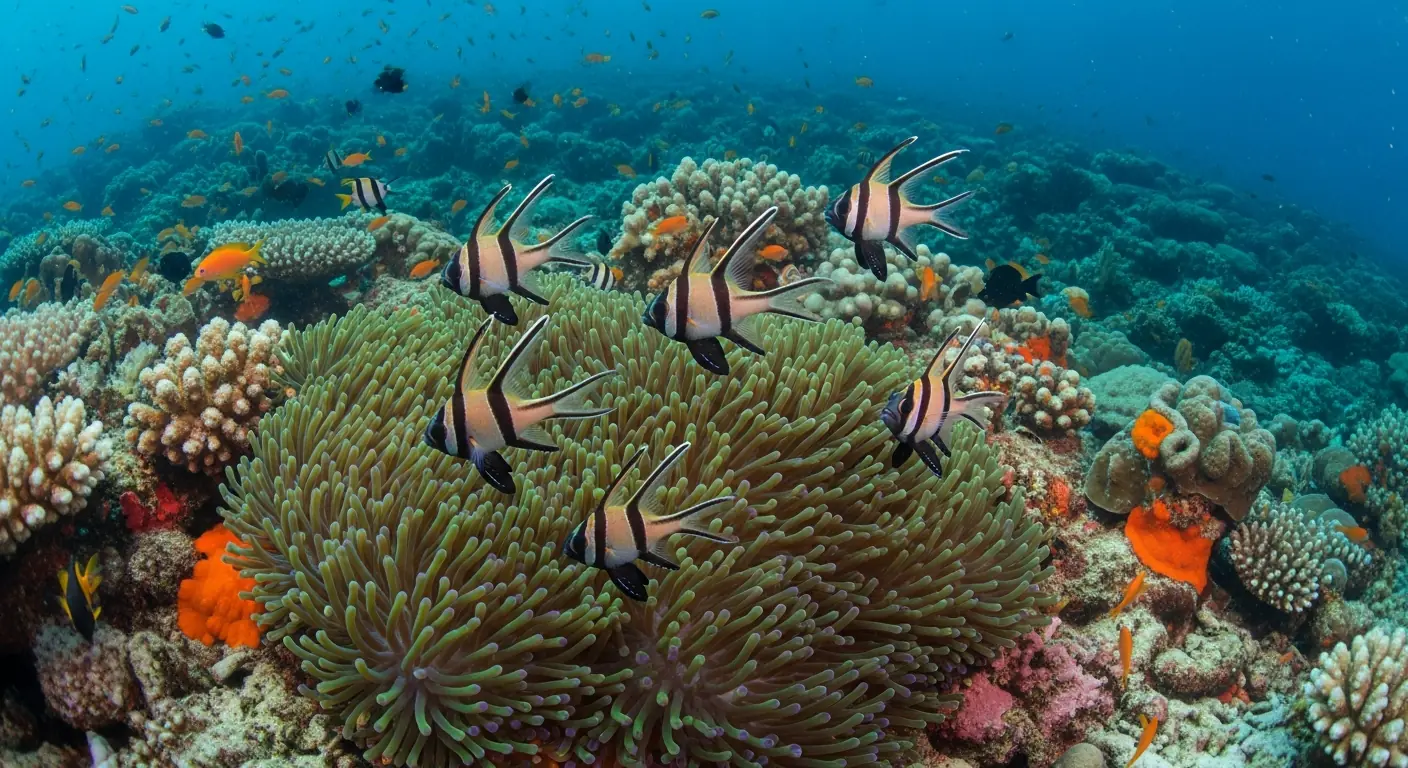
The waters surrounding the Banggai Islands shimmer with a distinct iridescence, where the currents dictate the rhythm of marine life and sunlight pierces the surface to illuminate intricate coral structures. This remote archipelago, situated off the eastern coast of Central Sulawesi, presents a unique confluence for divers and marine enthusiasts: the singular habitat of the Banggai cardinalfish set against a backdrop of vibrant, extensive reef systems. Access to these islands typically commences in Luwuk, a gateway to the broader Central Sulawesi marine environment, establishing the initial point of contact for journeys into this specific ecological zone.
The Endemic Banggai Cardinalfish: A Microcosm of Evolution
The Banggai cardinalfish (Pterapogon kauderni) defines the marine identity of the Banggai Islands. This small, strikingly patterned fish, characterized by its silver body adorned with black vertical bars and iridescent spots, is found nowhere else on Earth. Its survival and specific distribution are intrinsically linked to the shallow, sheltered waters of the archipelago, particularly around Banggai Island and Peleng Island. Divers frequently encounter these fish congregating among sea urchins, branching corals, and even discarded human debris like plastic bottles, which they utilize for shelter. Their unique reproductive strategy, where males orally brood the eggs, adds another layer to their biological significance. Conservation efforts are critical here, as the species faces pressures from habitat degradation and unsustainable collection for the aquarium trade. Understanding the specific microhabitats they occupy, from the sandy bottoms to the intricate nooks of coral gardens, is key to appreciating their delicate existence within this isolated ecosystem. The species’ limited range underscores the ecological importance of the Banggai Islands, making every sighting a connection to a rare evolutionary success story.
Exploring the Reefs and Dive Sites of Peleng Island
Peleng Island, the largest landmass within the Banggai Islands, offers a diverse array of coral reefs and dive sites that cater to various diving preferences. Its coastline is punctuated by numerous bays and coves, each harboring distinct underwater topographies. The reefs around Peleng exhibit a healthy mix of hard and soft corals, providing shelter and sustenance for a broad spectrum of marine fauna. Sites such as those off the southern and eastern coasts are known for their vibrant shallow reefs, often characterized by dense aggregations of table corals and massive brain corals. Deeper walls and slopes reveal gorgonian fans, barrel sponges, and occasional pelagic sightings. Visibility generally ranges from 15 to 30 meters, influenced by tidal movements and local weather patterns. Divers exploring Peleng’s waters can anticipate encounters with reef sharks, various species of snapper, fusiliers, and an impressive array of macro life, including nudibranchs, pygmy seahorses, and crab species. The underwater landscape around Peleng is a sign of the region’s marine biodiversity, presenting a less-explored frontier compared to more established Indonesian dive destinations, while still offering robust and active reef systems.
The Unique Submerged Lake of Paisu Pok
Beyond the ocean, Peleng Island holds a remarkable inland hydrological feature: Paisu Pok Lake. While not a conventional dive site, Paisu Pok offers an extraordinary snorkeling experience unlike any other in the region. This crystal-clear freshwater lake, translating to “black water” in the local dialect despite its stunning transparency, is fed by an underground spring. The water’s clarity is exceptional, allowing for uninterrupted views of the submerged trees and limestone formations that characterize its bottom. Snorkelers glide over a landscape that feels ethereal, where light filters through the canopy above and illuminates the silent, submerged forest below. The lake is relatively shallow, making it accessible for snorkelers of all skill levels, and its calm, warm waters provide a refreshing alternative to marine excursions. The ecological significance of Paisu Pok lies in its unique geological formation and the pristine condition of its freshwater environment, offering a distinct biological contrast to the saltwater habitats of the surrounding archipelago.
Understanding the Banggai Archipelago: Access from Luwuk
Accessing the Banggai Islands primarily begins in Luwuk, the capital of Banggai Regency on mainland Sulawesi. Luwuk is serviced by Syukuran Aminuddin Amir Airport (LUW), with daily flights from major Indonesian hubs such as Makassar (UPG) and Palu (PLW). From Luwuk, the journey to the Banggai Islands typically involves ferry or speedboat transfers. The main ferry terminal in Luwuk provides scheduled services to various islands within the archipelago, including Banggai Island and Peleng Island. Ferry schedules can vary, and it is advisable to confirm timings in advance, as services are often adjusted based on demand and weather conditions in the Banggai Sea. The Banggai Sea (Banggai Laut) Regency itself covers a substantial marine area of 12,156.78 square kilometres, underscoring the distances involved in inter-island travel. For divers, chartering a private speedboat offers flexibility and direct access to specific dive resorts or liveaboards, reducing travel time significantly compared to public ferries. This logistical framework positions Luwuk as the essential staging point for any expedition into the Banggai Islands.
Banggai Islands Regency: Population and Geographic Context
The Banggai Islands Regency encompasses a significant geographical area and supports a distinct population. Covering a land area of 2,488.79 square kilometres, the regency had a population of 120,142 at the 2020 census. The mid-2024 population estimate for Banggai Islands Regency reached 130,008 people, reflecting a modest growth. These figures highlight the human presence across this scattered archipelago, where local communities often rely on marine resources. The coordinates of the Banggai Islands Regency are approximately 1.408619°S, 123.206363°E, placing it firmly within the equatorial zone, which contributes to its tropical marine climate. Banggai Island itself, a focal point for visitors, has an area of 294.4 square kilometres and a population of 43,338 at the 2020 census, making it one of the more densely populated islands within the group. Understanding these demographic and geographic specifics provides context for the scale and distribution of human activity and its interaction with the natural environment across the Banggai Islands. The neighboring Banggai Sea (Banggai Laut) Regency, while distinct in its administrative boundaries, shares much of the same marine environment, covering a land area of 725.67 square kilometres and a vast marine area.
Central Sulawesi Marine Conditions and Conservation
The marine conditions in Central Sulawesi, particularly around the Banggai Islands, are characterized by tropical temperatures, generally calm seas during peak seasons, and nutrient-rich waters that fuel the diverse ecosystems. Water temperatures consistently range from 27°C to 30°C, suitable for year-round diving. Currents can vary from mild to strong, depending on lunar cycles and specific dive sites, necessitating careful planning for dives. The region falls within the Coral Triangle, a global epicentre of marine biodiversity, making its conservation paramount. Efforts here focus on protecting the Banggai cardinalfish from over-collection and habitat destruction, as well as preserving the extensive coral reefs. Local communities, often dependent on fishing, are increasingly involved in sustainable practices and marine protected area initiatives. Challenges include plastic pollution, illegal fishing methods, and the impacts of climate change on coral health. Organizations work with local authorities to establish and enforce regulations that protect vulnerable species and habitats, ensuring the long-term health of this critical marine environment. Divers play a role by adhering to responsible diving practices, minimizing impact on the delicate ecosystems, and supporting conservation-minded tourism operations.
The Banggai Islands offer a specific window into a unique marine world, where the rare Banggai cardinalfish thrives amidst vibrant coral reefs and distinctive geological features. For those seeking targeted marine exploration and an authentic connection to a globally significant ecosystem, these islands present a compelling destination. Discover more about the Banggai Islands and plan your expedition.